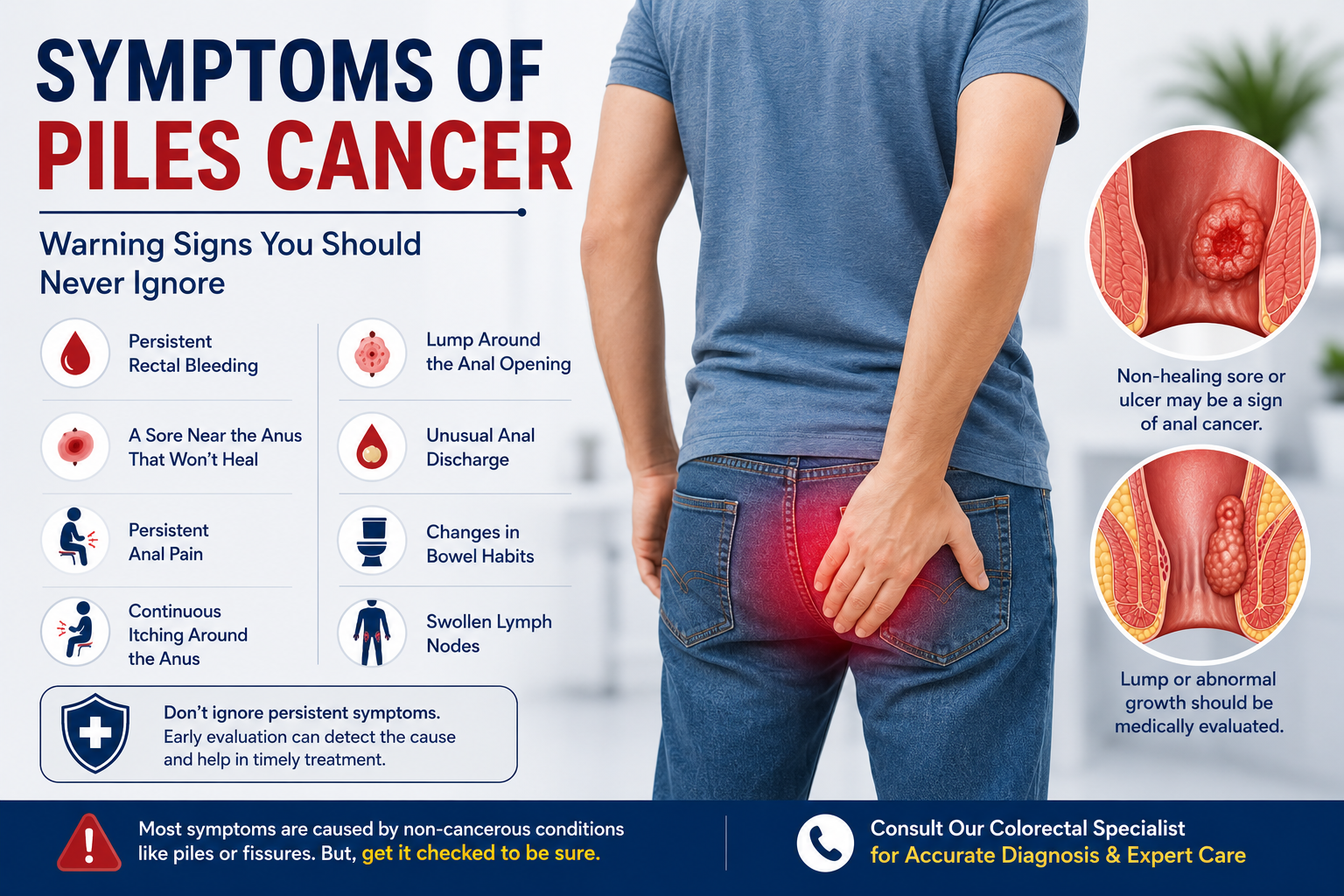
Many people experience discomfort around the anal region at some point in their lives. Symptoms such as pain during bowel movements, itching, bleeding, or small lumps are often assumed to be piles (hemorrhoids). While piles are extremely common and usually harmless, similar symptoms can occasionally indicate a more serious condition, including anal cancer.
This is why understanding the symptoms of piles cancer is important. Although hemorrhoids do not turn into cancer, the symptoms of anal cancer and advanced hemorrhoids can sometimes overlap. Misinterpreting these warning signs may delay diagnosis and treatment, allowing the disease to progress.
One of the most concerning signs is a sore near the anus that doesn't heal, especially when it continues for several weeks despite medication. Persistent bleeding, increasing pain, changes in bowel habits, or a growing lump around the anal opening should never be ignored.
Fortunately, anal cancer is relatively uncommon, and most people experiencing rectal discomfort are diagnosed with non-cancerous conditions such as piles, fissures, or fistulas. However, early evaluation by a colorectal surgeon is essential whenever symptoms persist or worsen.
At Sree Nandaka Advanced Surgery Hospital, our specialists evaluate every patient thoroughly with tests where needed, to identify the exact cause of anorectal symptoms and recommend the most appropriate treatment.
Can Piles Become Cancer?
One of the biggest misconceptions among patients is the belief that untreated piles eventually develop into cancer.
The answer is No.
Hemorrhoids themselves do not become cancerous. Piles are enlarged veins in the rectum or anus caused by increased pressure due to constipation, pregnancy, obesity, prolonged sitting, or straining during bowel movements.
Anal cancer, on the other hand, develops when abnormal cells grow uncontrollably in the tissues of the anal canal. It is a completely different medical condition with different underlying causes.
However, confusion arises because both conditions may produce similar symptoms, including:
- Rectal bleeding
- Pain during bowel movements
- Itching around the anus
- Swelling or lumps
- Discomfort while sitting
This overlap often causes patients to self-diagnose piles and delay seeking medical attention, even when more serious disease may be present.
If your symptoms continue beyond a few weeks, recur frequently, or fail to improve despite treatment, a proper examination is strongly recommended.
What Are the Symptoms of Piles Cancer?
Recognizing the early symptoms can make a significant difference in diagnosis and successful treatment.
Some of the most common symptoms of piles cancer include:
1. Persistent Rectal Bleeding
Bleeding during bowel movements is commonly associated with hemorrhoids. However, bleeding that continues despite treatment, becomes heavier, or occurs frequently should always be evaluated.
Cancer-related bleeding may not always be bright red and can sometimes be mixed with mucus or discharge.
2. A Sore Near the Anus That Won't Heal
This is one of the most important warning signs.
Unlike hemorrhoids, which usually improve with medications and lifestyle changes, a persistent ulcer or sore that remains for several weeks requires immediate medical assessment.
The sore may:
- Continue bleeding
- Produce discharge
- Become increasingly painful
- Develop hard edges
- Fail to heal despite treatment
3. Persistent Anal Pain
While piles usually cause discomfort during bowel movements, cancer-related pain often becomes continuous.
Patients may experience:
- Burning pain
- Sharp pain while sitting
- Constant discomfort
- Pain that gradually worsens over time
Persistent pain without improvement should never be ignored.
4. Lump Around the Anal Opening
A hemorrhoid usually appears as a soft swollen vein.
An anal cancer lump may feel:
- Hard
- Irregular
- Fixed in place
- Progressively increasing in size
Any new lump that continues to grow should be examined by a colorectal specialist.
5. Continuous Itching Around the Anus
Although itching is common in hemorrhoids, persistent itching associated with bleeding, pain, or discharge could indicate another underlying condition that requires medical evaluation.
6. Unusual Anal Discharge
Anal cancer may produce:
- Mucus
- Pus-like discharge
- Bloody discharge
- Foul-smelling fluid
These symptoms are uncommon in simple hemorrhoids and deserve prompt attention.
7. Changes in Bowel Habits
Patients may notice:
- Difficulty passing stools
- Narrow stools
- Feeling that the bowel doesn't empty completely
- Increased constipation
- Frequent urge to pass stools
These symptoms should be investigated if they persist for several weeks.
8. Swollen Lymph Nodes
In some cases, enlarged lymph nodes in the groin may develop as the disease progresses.
Although this occurs less commonly, it is an important symptom requiring urgent medical evaluation.
Key Takeaway
Most people experiencing rectal bleeding, itching, or pain have non-cancerous conditions such as piles or fissures. However, symptoms that are persistent, worsening, or unresponsive to treatment should always be evaluated by a qualified colorectal surgeon. Early diagnosis not only rules out serious conditions but also improves treatment outcomes if a more significant disease is present.
Piles vs Anal Cancer: How Can You Tell the Difference?
One of the biggest challenges for patients is distinguishing between hemorrhoids (piles) and anal cancer because both conditions may begin with similar symptoms such as rectal bleeding, itching, pain, or swelling. However, there are several important differences that can help identify when medical evaluation is necessary.
Piles vs Anal Cancer
- Piles: Soft swollen veins
- Anal Cancer: Hard or irregular lump
- Piles: Bleeding mainly during bowel movements
- Anal Cancer: Bleeding may occur anytime
- Piles: Symptoms improve with medication
- Anal Cancer: Symptoms continue or worsen
- Piles: Mild to moderate pain
- Anal Cancer: Persistent or severe pain
- Piles: Temporary itching
- Anal Cancer: Continuous itching with other symptoms
- Piles: No unexplained weight loss
- Anal Cancer: Weight loss may occur
- Piles: Usually heals within days or weeks
- Anal Cancer: Persistent sore that doesn't heal
Although this comparison provides general guidance, it is impossible to diagnose either condition based on symptoms alone. A physical examination and appropriate investigations are necessary to determine the exact cause.
Who Is at Higher Risk of Anal Cancer?
Anal cancer is relatively uncommon, but certain individuals have a higher risk than others.
Risk factors include:
- Human Papillomavirus (HPV) infection
- Smoking
- Age above 50 years
- Weakened immune system
- HIV infection
- Previous history of cervical, vulvar, or vaginal cancers
- Multiple sexual partners
- Chronic anal inflammation
- Long-standing anal fistulas in rare cases
Having one or more of these risk factors does not necessarily mean a person will develop anal cancer. However, awareness and regular medical evaluation can help detect abnormalities early.
When Should You See a Doctor Immediately?
Many people delay seeking medical advice because they assume rectal bleeding is "just piles." While this is true in many cases, certain symptoms should never be ignored.
Consult a colorectal specialist immediately if you notice:
- Bleeding that continues for more than two weeks
- A sore near the anus that refuses to heal
- Increasing pain around the anal region
- A growing lump near the anus
- Persistent itching with bleeding
- Mucus or pus discharge
- Difficulty passing stools
- Unexplained weight loss
- Swelling in the groin
- Symptoms that return repeatedly despite treatment
Early diagnosis significantly improves treatment outcomes and helps prevent complications.
How Is Anal Cancer Diagnosed?
If your doctor suspects that your symptoms require further evaluation, several diagnostic tests may be recommended.
Physical Examination
The doctor carefully examines the anal region to identify swelling, ulcers, abnormal growths, or suspicious lumps.
Digital Rectal Examination (DRE)
A gloved, lubricated finger is gently inserted into the rectum to feel for abnormal masses or irregularities inside the anal canal.
Anoscopy or Proctoscopy
A small instrument with a light source allows the doctor to visualize the anal canal and lower rectum more clearly.
This helps identify:
- Ulcers
- Polyps
- Tumors
- Internal hemorrhoids
- Areas of inflammation
Biopsy
If an abnormal growth is found, a small tissue sample is collected and examined under a microscope.
A biopsy is the only definitive method for confirming whether cancer cells are present.
Imaging Tests
Depending on the findings, additional imaging may include:
- MRI
- CT Scan
- PET Scan
- Ultrasound
These tests help determine the size of the tumor and whether it has spread to nearby tissues or lymph nodes.
Can Symptoms Be Caused by Conditions Other Than Cancer?
Absolutely.
Most patients experiencing anal pain or bleeding are diagnosed with non-cancerous conditions.
These include:
- Hemorrhoids (Piles)
- Anal Fissure
- Anal Fistula
- Perianal Abscess
- Skin Tags
- Rectal Polyps
- Proctitis
- Inflammatory Bowel Disease (IBD)
Because these conditions often produce symptoms similar to anal cancer, professional evaluation is the safest approach whenever symptoms persist.
Why Early Diagnosis Matters
Like many other cancers, anal cancer is far more treatable when detected early.
Benefits of early diagnosis include:
- Less extensive treatment
- Better treatment outcomes
- Reduced complications
- Improved quality of life
- Lower risk of cancer spreading
- Shorter recovery for many patients after treatment
Ignoring symptoms in the hope that they will disappear can delay diagnosis and make treatment more complex.
Care at Sree Nandaka Advanced Surgery Hospital
At Sree Nandaka Advanced Surgery Hospital, we understand that symptoms such as rectal bleeding, pain, itching, or persistent sores can be alarming. Our colorectal specialists provide a thorough evaluation with tests where needed, to identify the exact cause of your symptoms.
Whether the problem is hemorrhoids, fissures, fistulas, or another anorectal condition, our team focuses on accurate diagnosis, personalized treatment plans, and compassionate patient care. If further investigations are required, they are performed with precision to ensure timely and appropriate management.
Early consultation can provide reassurance, relieve symptoms, and, when necessary, enable prompt treatment for serious conditions.
Treatment Options for Anal Cancer
If anal cancer is diagnosed, treatment depends on several factors, including the stage of the cancer, its size, location, and the patient's overall health. Modern treatment approaches have significantly improved outcomes, especially when the disease is detected in its early stages.
Treatment may include one or a combination of the following:
1. Chemoradiation Therapy
For many patients, chemotherapy combined with radiation therapy is considered the standard treatment. This approach helps destroy cancer cells while preserving the anal sphincter in many cases, reducing the need for major surgery.
Benefits include:
- Effective control of early-stage cancers
- Preservation of normal bowel function in many patients
- Reduced risk of cancer recurrence
- Improved long-term outcomes
2. Surgery
Surgery may be recommended if:
- The cancer does not respond completely to chemoradiation.
- The disease returns after treatment.
- The tumor is extensive or causing significant complications.
The surgical procedure depends on the extent of the disease and is planned carefully by a colorectal surgeon.
3. Targeted and Advanced Therapies
For selected patients with advanced or recurrent disease, newer treatment options may include:
- Immunotherapy
- Targeted therapy
- Clinical treatment protocols based on individual patient evaluation
Your treating specialist will determine the most appropriate treatment plan after thorough assessment.
Can Anal Cancer Be Prevented?
Although not every case can be prevented, adopting healthy lifestyle habits and addressing risk factors can reduce the likelihood of developing anal cancer.
Preventive Measures
- Maintain good anal hygiene.
- Avoid smoking and tobacco use.
- Treat chronic anorectal conditions promptly.
- Manage constipation with a high-fiber diet and adequate hydration.
- Practice safe sexual health measures.
- Attend regular health check-ups if you have high-risk factors.
- Do not ignore persistent rectal bleeding or anal pain.
Early medical consultation remains the most effective way to detect serious conditions before they become advanced.
When Is Rectal Bleeding an Emergency?
While hemorrhoids are a common cause of rectal bleeding, immediate medical attention is recommended if you experience:
- Heavy or continuous bleeding
- Severe pain with bleeding
- Black or tarry stools
- Persistent bleeding lasting more than two weeks
- Fever associated with anal swelling
- Rapidly enlarging lump near the anus
- Dizziness or weakness due to blood loss
These symptoms require urgent medical evaluation to determine the underlying cause.
About Care at Sree Nandaka Advanced Surgery Hospital
At Sree Nandaka Advanced Surgery Hospital, patients receive comprehensive evaluation and evidence-based care for a wide range of anorectal conditions.
Our Approach Includes:
- Colorectal and gastrointestinal surgeons
- Diagnostic facilities
- Comprehensive evaluation of rectal bleeding and anal pain
- Personalized treatment plans
- Minimally invasive surgical options whenever appropriate
- Patient-centered care with complete confidentiality
- Guidance on lifestyle modifications and long-term recovery
Our goal is to provide accurate diagnosis, timely intervention, and compassionate care so that every patient receives the most appropriate treatment.
Final Thoughts
Experiencing symptoms such as rectal bleeding, itching, pain, or a lump near the anus can be concerning. While these symptoms are often caused by common conditions like hemorrhoids or anal fissures, they should never be ignored if they persist, worsen, or fail to improve with treatment.
It's important to remember that hemorrhoids do not turn into cancer, but the symptoms of anal cancer can closely resemble those of piles. This similarity is why self-diagnosis can sometimes delay appropriate treatment.
If you notice a sore near the anus that won't heal, persistent bleeding, unexplained pain, or a growing lump, consult a qualified colorectal specialist without delay. Early diagnosis allows treatment to start sooner.
At Sree Nandaka Advanced Surgery Hospital, our specialists are committed to helping patients with accurate diagnosis, treatment options, and compassionate support at every stage of care.
Frequently Asked Questions (FAQs)
1. Can piles become cancer?
No. Hemorrhoids (piles) do not transform into cancer. However, some symptoms of anal cancer can resemble piles, making medical evaluation important when symptoms persist.
2. What is the biggest warning sign of anal cancer?
A persistent sore near the anus that does not heal, continuous rectal bleeding, a hard lump, or worsening pain should be evaluated by a doctor.
3. Is every anal lump cancerous?
No. Most anal lumps are caused by hemorrhoids, skin tags, abscesses, or cysts. Only a medical examination can determine the exact cause.
4. When should I see a doctor for rectal bleeding?
If rectal bleeding continues for more than two weeks, recurs frequently, or is accompanied by pain, discharge, weight loss, or a persistent lump, seek medical evaluation promptly.
5. Can anal cancer be cured?
Yes. When detected early, anal cancer can often be treated effectively with appropriate medical care.
6. What tests are used to diagnose anal cancer?
Diagnosis may involve a physical examination, digital rectal examination, anoscopy, biopsy, and imaging tests such as MRI or CT scans.
7. How do I know if it's piles or something more serious?
Persistent symptoms, a non-healing sore, increasing pain, unexplained weight loss, or a hard lump require evaluation by a colorectal specialist to rule out more serious conditions.
Book a Consultation at Sree Nandaka Advanced Surgery Hospital
If you're experiencing persistent rectal bleeding, anal pain, itching, or a lump near the anus, don't rely on self-diagnosis. A timely consultation with a colorectal specialist can help identify the exact cause and ensure appropriate treatment.
Sree Nandaka Advanced Surgery Hospital offers comprehensive evaluation and care for piles, fissures, fistulas, and other colorectal conditions, with a focus on accurate diagnosis and patient-centered treatment.
Book a Consultation at Sree Nandaka Advanced Surgery Hospital
If you're experiencing persistent rectal bleeding, anal pain, itching, or a lump near the anus, don't rely on self-diagnosis. Consult a colorectal specialist for accurate evaluation and appropriate treatment.
Book Consultation